How to Prevent Raw Material Shortages and Production Delays in Printing & Packaging Manufacturing
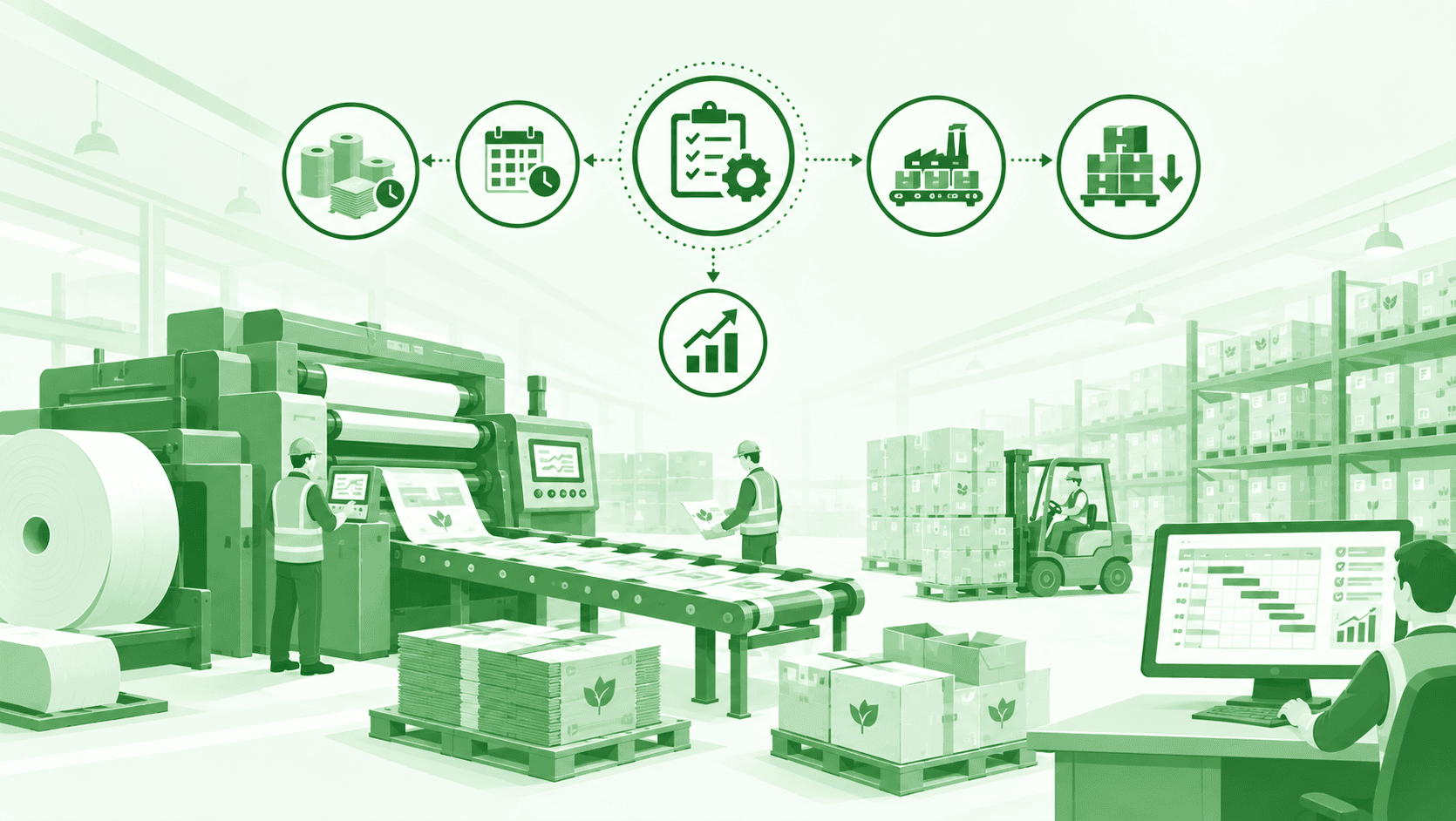
The press is ready. The job is scheduled. The customer is waiting — and the board hasn't arrived.
Sound familiar? In printing and packaging, many material-led production delays start before the job ever reaches the shop floor. They start weeks earlier — in a purchase order raised late, a stock figure nobody trusts, or a reorder level set once and never revisited.
Here's the uncomfortable part — what looks like a raw material shortage is often a visibility or planning problem in disguise.
Why shortages keep catching packaging plants off guard
Walk into a busy converting or printing unit and you'll usually find plenty of material — reels of film, pallets of kraft board, ink drums near pre-press. And yet the one substrate the next job needs is missing.
Packaging material management is messy by nature. A single order can call for a specific GSM, flute, film thickness, ink shade and adhesive — each with its own supplier lead time. Multiply that across a few hundred active SKUs and keeping track gets hard, fast.
Three patterns show up again and again:
- Stock on paper, not on the rack. System figures drift because issues, returns and part-reels aren't logged in real time.
- Planning without material checks. Jobs reach the press before anyone confirms the substrate is available.
- Reorder levels frozen in time. Minimum stock was set on last year's demand — not this quarter's order book.
That's why raw material inventory management is less about counting stock and more about trusting the count.
Flip it — plan material before machines
Many plants schedule the press first and chase material later. Flip it. Confirm material availability the moment an order is accepted, and the press schedule becomes something you can actually keep.
When a job comes in, one question should be answered straight away: do we have everything it needs — and if not, when will we?
Good material planning in packaging manufacturing answers it the same way, for every order:
- Order
- Material requirement
- Live stock
- Shortage check
- Procurement
- Job release
- Order. The job is confirmed with quantity, specs and delivery date.
- Material requirement. The bill of materials turns that order into exactly what the job needs — substrate, GSM or film structure, ink, plates or cylinders, adhesive.
- Live stock. Check what's physically available, not just what the system shows, and what's already reserved for other jobs.
- Shortage check. Anything missing gets flagged now, while there's still time to act.
- Procurement. Purchase is raised against the supplier's real lead time.
- Job release. The job goes to the press only when its material is confirmed.
Break any link and the shortage surfaces later — often at the press, where it costs the most to fix.
This is where packaging inventory management stops being a stores function and becomes a planning function.
Five steps to prevent material-led delays
- 01Fix stock accuracy first. No software fixes bad data. Start cycle counts on fast-moving substrates, tag part-reels and offcuts, and use barcode or QR-based identification so every receipt, issue, return and part-reel is captured at source.
- 02Classify materials by risk, not just value. ABC analysis tells you what's expensive. Add lead time and supplier risk, and you'll know what's dangerous — an imported film with a six-week lead time deserves more attention than a high-value local ink.
- 03Set dynamic reorder points. Tie minimum stock to actual consumption and confirmed orders, and review them monthly.
- 04Check material before every job release. If substrate, ink or plates aren't confirmed, the job doesn't go to the press. Simple rule, massive difference.
- 05Track consumption variance and waste job by job. Compare what each job actually used with what was planned, so unplanned material loss doesn't quietly eat the buffer meant for future jobs. Standard ink recipes and tighter changeovers help keep make-ready waste in check.
Where technology actually helps
Can a spreadsheet do all this? For five SKUs, maybe. For five hundred, it starts to break.
Once the process is clear, the right system connects orders, BOMs, purchase and stores, so the chain above runs on live data instead of follow-up calls. Whether that's a packaging ERP or a set of connected tools, it should give you:
- Real-time stock by substrate, size, GSM and location
- Automatic material reservation against confirmed orders
- Shortage alerts before a job is scheduled, not after
- Supplier lead-time tracking and purchase suggestions
- Job-wise consumption and waste reporting
The specifics depend on your line. An ERP for the corrugated packaging industry has to handle board grades and flute combinations. Flexible packaging brings reel-level film, lamination structures and cylinder availability into the picture. Either way, the system needs to reflect the material structures and production workflow of your operation.
Software alone won't fix it
Plenty of plants invest in software and still run out of board. The tool was installed — the process wasn't redesigned.
The fix is both: clean up stores discipline and planning rules on the floor, then digitise what works.
At Gemba Concepts, the process comes first. Once material planning, stores discipline and job-release rules are clear, the right digital layer — ERP, WMS or configured operational workflows — can make the improved process visible and repeatable.
The bottom line
Raw material shortages are rarely just bad luck. More often, they're a signal — of stock you can't see, plans made without material checks and reorder rules nobody updates.
Fix visibility. Plan material before machines. Then use technology to keep that discipline in place.
If material availability is regularly changing your production plan, start by mapping where visibility breaks between order, stores, purchasing and production.

Written by Mohit Bafna
Co-Founder, Gemba Concepts
Want This Fixed in Your Plant?
Talk to Gemba ConceptsFrequently asked questions
Continue Reading
How to Improve Production Planning and Reduce WIP in Printing & Packaging Manufacturing
Printed sheets waiting for lamination, laminated reels waiting for slitting, die-cut blanks waiting for gluing. Everything's moving. Nothing's finishing.
How to Reduce Scrap, Material Waste and Rework in Personal Hygiene Manufacturing
Nonwoven trimmings. SAP overshoot. Wet wipes rejected for saturation variance. Every one is material that was paid for, processed, sometimes packed, and then written off.
Inventory Management in Personal Hygiene Manufacturing: How to Reduce Shortages, Excess Stock and Production Delays
Sanitary pads short while adult diaper cartons block the aisles. Handwash pumps missing while lotion caps arrive in triplicate. The pattern is familiar — the costs are not always visible.
Industrial Businesses Across 3 Continents