
What Pharma Consultants See Between Batches, That Plants Often Miss
Some of the gap between batches is required process. The rest is waiting for a plan, a document, a clearance or a person — and that part is capacity you already paid for.
Key Takeaways
- 01
Not every hour between batches is a loss. Required process time — cleaning, drying, clearance, documentation — belongs exactly where it is. The opportunity is the coordination waiting around those controls.
- 02
Plants measure the run in seconds — output, yield, OEE. Almost nobody holds the full batch-to-batch turnaround, and the split inside it, in one place — so the biggest capacity opportunity sits in a number that has never been assembled.
- 03
A machine constraint may justify a new line. A flow constraint will not be fixed by one — it follows the plant into the new line, with the same planning cycle, stores and quality team behind it.
The Batch That Started at Two O'Clock
The next batch started at two o'clock on Monday afternoon.
Some of those hours had to happen. There was cleaning and sanitization. There was drying and equipment preparation. There was line clearance, and there was documentation that had to be completed and verified before anything else could begin. None of that is waste, and none of it should be taken out.
But some of those hours were a different thing entirely. The cleaning cycle could not begin until the previous batch record had been reconciled. The clearance waited for somebody to become free. A material status could not be confirmed until the stores in-charge came in on Saturday morning. And a plan that had changed quietly on Thursday had not yet reached two of the four departments.
Sixty-four hours in total. Only part of it was required.
Not Every Hour Between Batches Is Waste
This distinction decides whether the number is useful or misleading.
Some of the time between batches is required controlled process time — cleaning, sanitization, drying, equipment preparation, line clearance, hold times, sampling and testing where required, documentation and verification. Those hours belong exactly where they are.
The operating opportunity sits in the time around those controls. Waiting for information, for people, for a material status, an approval, a handover or a revised plan to reach everybody.
Required time is the process working. Waiting time is coordination that has not yet been designed.
The Run Gets Measured. The Turnaround Often Does Not.
Ask a plant head how his line is performing and you will get a number in seconds. Output, yield, downtime, OEE. Somebody stands next to the line while it runs, so the number exists.
Now ask a different question. How many hours pass between the end of one batch and the start of the next — and how much of that was genuinely required?
Many plants measure each activity separately but do not manage the full batch-to-batch turnaround as one operating number. Cleaning has a time. Clearance has a time. Documentation has a time. What is rarely held in one place is the total, and inside the total, the split.
So flip the usual assumption. If the plant is short of capacity, the machine is only one candidate — and it is the one you already measure.
Where the Hours Actually Go
Follow a few full cycles honestly — not the run, the turnaround — and the same six things appear in plant after plant.
- The plan changes after it is released. Monday's plan is not Wednesday's plan. Production is working from one version, the warehouse from another; quality finds out when the paperwork arrives. Nobody is careless. There is simply no single place where the current plan lives.
- Material status is not clear at the line. The material is inside the plant. Whether it is available, under test, released, blocked or short is spread across a register, an email and a phone call. Five words decide whether a batch starts on time, and they are rarely visible in one place.
- Planned changeover and actual changeover are two different numbers. The plan allows four hours. The floor is handling cleaning, verification, label reconciliation and the last batch's documents. Neither figure is wrong. One measures the changeover; the other measures everything that happens around it.
- Line clearance waits on a person, not on the work. The clearance itself takes what it takes. The waiting happens because nobody told quality in advance that it was coming, so it starts when somebody becomes free.
- The batch record holds up the next controlled start. Entries made at the end of the shift instead of at the point of work. A correction done twice. A query sitting with no named owner and no due time.
- Downtime and rescheduling land on top of all of it. One breakdown moves four batches, and agreeing the recovery plan takes longer than the repair did.
A Machine Constraint and a Flow Constraint Are Not the Same Problem
Across a month, the avoidable share alone often runs into several production days — on batches where nothing actually went wrong.
This is usually where the conversation turns to capex. Demand is strong, exports are growing, and another line looks like the obvious answer.
Sometimes it is. A machine constraint may justify capex. A flow constraint demands a different intervention. The expensive mistake is confusing one for the other.
Adding installed capacity does not automatically remove planning, material, handoff or shared-resource constraints. Those follow the plant into the new line, and arrive with the same quality team, stores and planning cycle behind them.
That does not mean do not build. It means separate the two before deciding.
And to be clear, none of this is about doing less checking. The controls stay exactly as they are. The only question is how much time is being lost around them, inside the process you already run.
Three Things Worth Doing This Week
- Measure one number. Take ten recent turnarounds on one line. Record the hours from batch end to the next productive start. Not an estimate — the actual times off the log.
- Split planned from actual. Put the planned changeover time and the actual changeover time side by side for the same ten batches. The difference is usually the most honest conversation your team will have that month.
- Fix the loudest one first. Not all six. The one that showed up in eight of those ten turnarounds.
The Run Tells You How the Line Performed
Your own team can start by following one line, one product family and ten recent batch-to-batch cycles.
The run tells you how the line performed. The gap tells you how the plant performed.
Run the Pharmaceutical Batch Flow Simulator
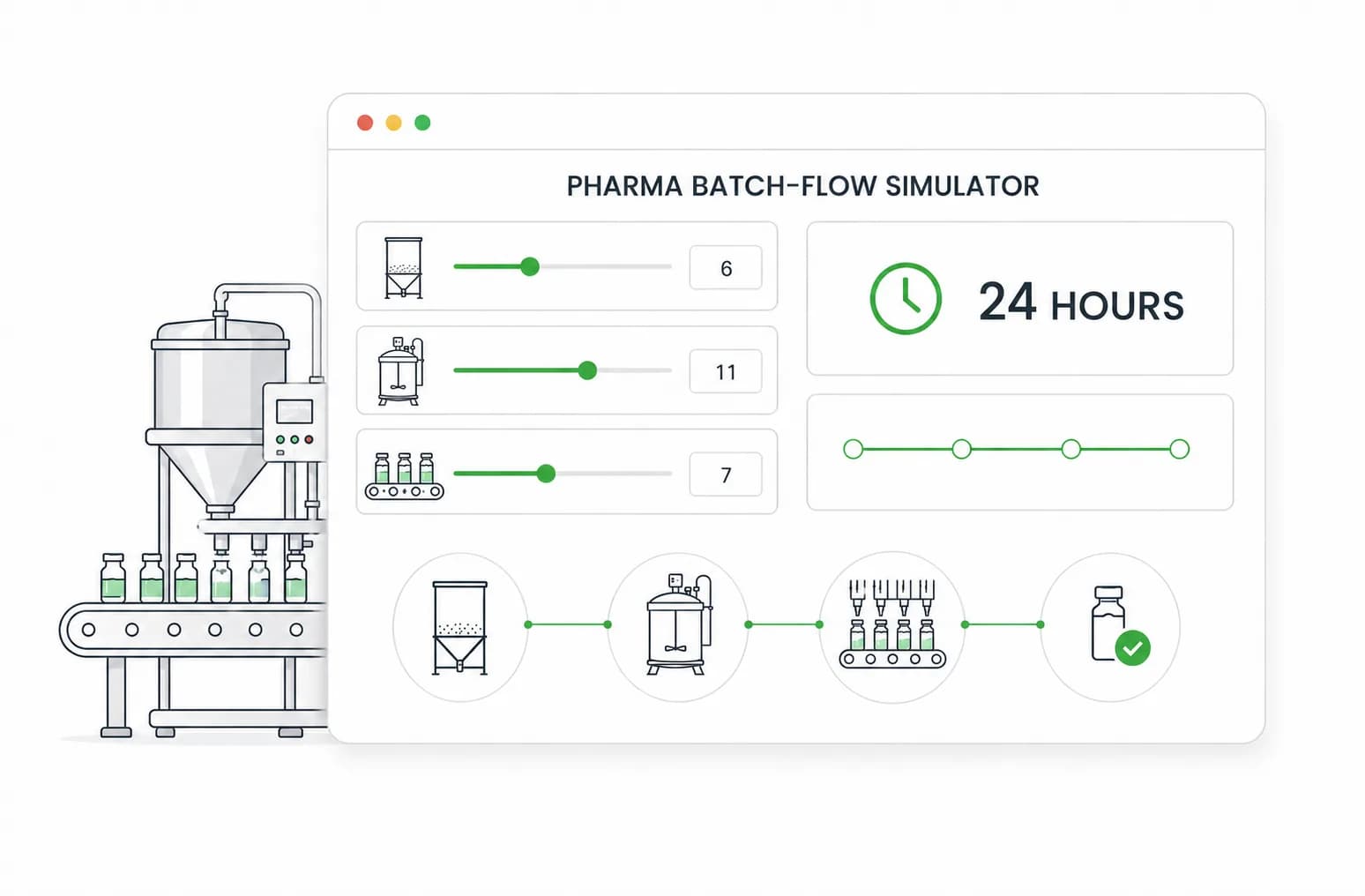
Follow one batch from raw material receipt through to QA release and dispatch. Enter the waiting time at six points and see the total delay, the hours it builds up across a month, the value sitting still and the stage holding the batch up. Three minutes.

Download the 10-Batch Time-Loss Tracker
A workbook for your next ten batches: record the actual timestamps, name the waiting point each time and total the time by category. It ends with seven questions worth asking before another line is approved.
What is the gap between batches actually worth?
Enter your batch rhythm, classify where the waiting accumulates, and the model returns addressable hours, additional batches, and an indicative monthly value — live, as you change the numbers.
Bring the completed tracker to a 20-minute operating conversation.
We will tell you which gap to investigate first.
This work does not assess regulatory compliance. It looks at operating time being lost inside the controlled process you already follow.