
The Two-Week Test
Your best dough handler goes on leave for two weeks. Does outlet #12 still turn out the same crust? The same rise, the same char, the same bite?
If you hesitated for even a second, here's what that hesitation actually means: the recipe is documented, but the process is not controlled. What you have isn't a system yet — it's a performance that happens to repeat itself, for as long as the one person holding it together doesn't take a vacation.
That gap has a name, and three questions sit underneath it. Why does it happen? How does it happen when every pizzeria follows the same rulebook? And what do the brands that don't decline actually do differently?
First, the Objection Worth Addressing: Does Standardising Kill the Craft?
Every culinary head has this reaction. The moment you say "standardise," it sounds like the recipe gets reduced to a checklist — the craft flattened into a formula, the chef replaced by a form.
Flip it. Standardisation doesn't mean removing culinary judgement. It means controlling the variables that should not drift, while preserving the skill that gives the product its character. Consistent food quality across outlets isn't the enemy of craft — it's the proof that the craft is real.
Restaurant consistency and uniformity are not the same thing. Consistency means the critical variables are controlled — dough weight, oven temperature, proofing time, sauce quantity. It leaves room for skill. It just makes sure that skill produces the same result every time, not only on good days.
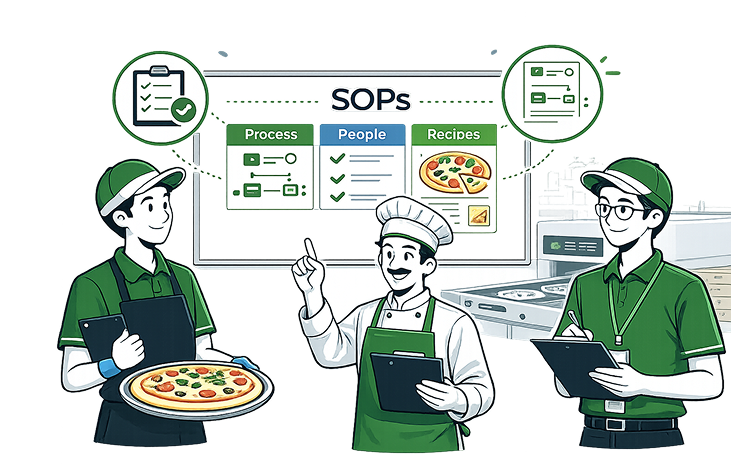
A restaurant SOP doesn't remove the chef from the kitchen. It makes sure the recipe survives contact with fifty different kitchens, on fifty different days, run by fifty different people who never met the chef who wrote it.
Why Quality Actually Declines: Tribal Knowledge Is the Real Enemy
Most brands won't say this out loud: the process on paper was never the real problem. What the process depends on is the problem.
Tribal knowledge — the kind that lives in someone's hands, in someone's memory, in "we just know how it should look" — does its job right up until it doesn't. When the experienced hand leaves for two weeks, transfers to another outlet, or simply has an off shift, quality moves with them.
The root cause is variation. And variation in a pizza kitchen SOP environment comes from four sources — not one:
- Man — skill, training and judgment vary by person, shift and tenure. Typical failure: the dough handler goes on leave, a new hire eyeballs hydration, and crust texture shifts.
- Machine — ovens drift, mixers wear, scales go uncalibrated over time. Typical failure: the oven thermostat reads 280°C, actual temperature is 265°C, and the base doesn't char correctly.
- Material — flour protein, cheese moisture and sauce viscosity all vary by batch and supplier. Typical failure: a local flour substitution changes dough behaviour, and no one catches it until complaints arrive.
- Method — restaurant standard operating procedures define this step, but SOPs alone don't hold it. Typical failure: "till it looks right" slowly becomes a different standard at every outlet.
An SOP Defines the Standard. A Control System Verifies It.
Restaurant standard operating procedures define the Method. They do nothing about Man, Machine, or Material without training, measurement, audits, and corrective action in restaurant operations built around them.
Problems must travel back into the operating system rather than dying in reviews or outlet-level conversations. When they don't, the same failure reappears at the same outlet, from the same cause, on the next busy Friday.
A functional system must:
- Train people against the standard before they work independently
- Measure the critical variables at defined intervals
- Detect deviation before it reaches the customer
- Assign corrective action to a named owner
- Feed recurring issues back into the process — not just into a shift debrief
The Controls That Actually Matter
Not everything in a pizza kitchen is equally consequential. These are the variables where uncontrolled variation most directly affects the finished product — the ones at the centre of any real pizza quality control system:
- Dough-ball weight (Dough) — the starting point for crust diameter and thickness; variation here compounds at every downstream stage. Weighed and logged per batch.
- Proofing time and temperature (Dough) — determine rise, flavour development and crust structure; both variables must be controlled together. Timer and thermometer, logged per batch.
- Dough age at use (Dough) — over-proofed dough degrades; under-proofed dough won't stretch correctly. Batch timestamp, with a use-by window enforced.
- Sauce quantity (Assembly) — affects flavour balance and crust texture; a common source of outlet-to-outlet variation. Ladle with volume marking, or weight.
- Cheese quantity (Assembly) — affects cost, coverage and melt; the most common source of customer complaints. Weighed per order and spot-checked on audits.
- Oven temperature (Baking) — determines bake time, char level and base colour; drift here affects every pizza on that shift. Calibrated probe, logged at shift start and mid-shift.
- A note on bake time — a defined time–temperature window, supported by a finished-product visual standard, reduces operator-to-operator variation. "Looks done" does not.
What Sustained Quality at Scale Actually Looks Like
These are examples drawn from the variables that move most frequently. The full CTQ Matrix helps operators define standards, tolerances, ownership and corrective action needed for their own process — across every stage from sourcing to service.
The brands that have sustained quality at scale — across countries, franchise models and decades — didn't rely on better recipes. They controlled the variables that should never depend on individual memory. Domino's uses a hub-and-spoke commissary model with centrally processed ingredients, fixed distribution cycles and POS-based inventory tracking, while Papa John's runs regional Quality Control Centers that produce fresh dough, supply restaurants on schedule and manage suppliers through structured compliance.
The principle is the same: standardise the parts of the process that shouldn't depend on individual judgement, and ensure problems move back up the chain instead of stopping at the outlet. Centralised production isn't the answer for every pizza concept — consistent control is.
Find Out Where Your Process Actually Breaks
Your restaurant SOP may be documented. But is your pizza actually controlled? Quick gut check:
- 1. Does every outlet weigh dough balls — or does "roughly the right size" still happen?
- 2. Are oven temperatures logged at shift start, or just assumed to be correct?
- 3. When a vendor substitution happens at outlet level, does head office know the same day?
- 4. Can you trace a customer complaint from last Tuesday back to a specific batch code and shift?
- 5. When a complaint comes in three times from the same outlet, does it change the SOP — or just prompt a call to the manager?
Find Your Gap Before Your Next Customer Does
If you hesitated on more than one, the gap is real. And it's the same gap that is one bad shift away from becoming your next 2-star review.
Every pizza brand says "we never compromise on quality." Most of them find out they were wrong about that from a stranger, in public, on Google.
Run the Multi-Outlet Pizza Consistency Diagnostic to score where quality depends on systems and where it still depends on individual judgement. Then use the accompanying Critical-to-Quality Control Matrix to define what must be measured, by whom, and what happens when standards slip.
The next person to find your gap shouldn't be a customer. Download the Multi-Outlet Pizza Consistency Diagnostic below.
Key Takeaways
- A documented recipe is not a controlled process. If quality depends on one person's hands, what you have is a performance that happens to repeat itself — not a system.
- Variation comes from four sources: Man, Machine, Material and Method. Restaurant SOPs only define the Method — training, measurement, audits and corrective action must cover the rest.
- Control the Critical-to-Quality variables: dough-ball weight, proofing time and temperature, dough age at use, sauce and cheese quantity, and oven temperature.
- An SOP defines the standard; a control system verifies it. Problems must travel back into the operating system instead of dying in shift debriefs.
- Brands that sustain quality at scale standardise the parts of the process that should never depend on individual judgement. Centralised production is optional — consistent control is not.
Free Download
Download the Multi-Outlet Pizza Consistency Diagnostic
Score where quality depends on systems — and where it still depends on individual judgement. Click the button, fill in your details, and the checklist downloads instantly.
Multi-Outlet Pizza Consistency Checklist (PDF)
A 38-point operating review for product, speed, food safety and outlet repeatability
Free download — takes less than a minute.