The Growing Pain Every Food Brand Hits
Your first pizza outlet is a hit. The dough is perfect. Customers rave about it. Then you open outlet two, three, four — and something feels off. The same recipe, somehow, tastes different. One outlet is fast and friendly. Another is slow and messy. Customers notice. Reviews get mixed. And you, the founder, start wondering — how do bigger brands keep every single outlet feeling the same?
This is one of the most common growing pains in the food business. It's not a recipe problem. It's a restaurant operations management problem — and it has a fix.
What Does "Operations" Actually Mean for a Food Brand?
Operations is simply how work gets done, every day, in every outlet — from how dough is prepped in the morning, to how a server greets a customer, to how a manager checks stock at closing time.
When you have one outlet, operations live in your head. You walk in, you fix things, you train people yourself. But once you have three, five, or ten outlets across different cities, you cannot be everywhere. That's when operations need to become a system — something written down, trainable, and checkable instead of something only the founder understands.
Consistency Is the Real Product, Not Just the Pizza
Customers don't just buy pizza. They buy a promise: this will taste and feel the same, every time, everywhere. Big, trusted food brands didn't win because they had the single best pizza recipe. They won because a customer in one city gets the same experience as a customer in another.
When consistency slips, trust slips with it. And trust, once lost across multiple outlets, is far harder to win back than it was to build in outlet one.
Why Processes Break Down as You Add Outlets
As a gourmet food brand expands into different markets, a few things typically go wrong with restaurant operations management:
- Tribal knowledge instead of written systems — the best practices exist only in the head of one experienced chef or manager.
- Different local habits — each outlet manager solves problems their own way, so "the same recipe" quietly turns into five different versions.
- No regular floor checks — leadership visits outlets rarely, so small drifts in quality go unnoticed until customers complain.
- Fast hiring, slow training — new outlets open quickly, but staff training doesn't keep pace, so quality control depends on luck.
- No feedback loop — problems found in one outlet are never shared with the others, so the same mistake repeats city after city.
Four Steps to Build Repeatable Operations Across Every Outlet
None of these problems are about talent or effort. They're about missing systems — here's how to build them.
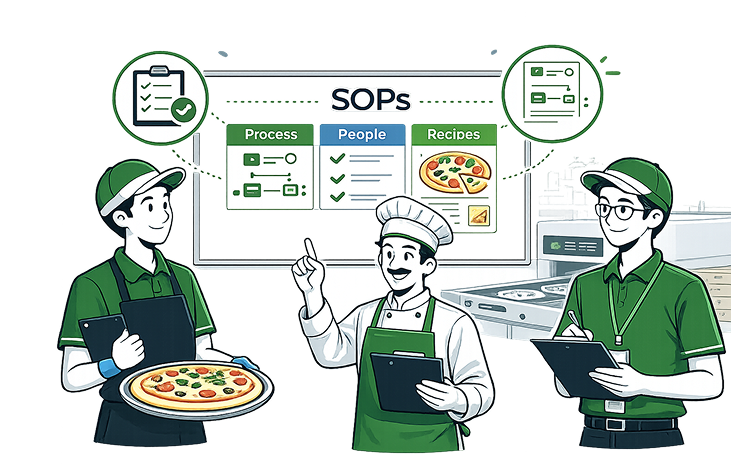
1. Turn Tribal Knowledge Into Written SOPs. A Standard Operating Procedure (SOP) is simply a clear, written set of steps for doing one task the same way every time: how to prep dough, how to plate a pizza, how to greet a walk-in customer. If it's not written down, it's not repeatable.
Quick tip: start with the 10 tasks that most affect taste and customer experience. Perfect those SOPs first, then expand.
2. Train Every Outlet the Same Way. Written SOPs only work if every new hire, in every city, learns them the same way. This usually means a short, standard training program — videos, checklists, and hands-on practice — instead of "shadow someone for a week and figure it out."
3. Build a Feedback Loop Between Outlets. When one outlet finds a smarter way to prep faster or reduce waste, that fix should travel to every other outlet, not stay stuck in one city. A monthly ops review, where outlet managers share what worked and what didn't, turns individual fixes into brand-wide improvements.
4. Audit, Adjust, Repeat. Systems aren't "set and forget." As the brand grows into new markets, SOPs need small adjustments — a new city might need a slightly different supplier or delivery process. The system stays the same; small details flex around it.
Where Growing Food Brands Go Wrong
These are the patterns that quietly break consistency as outlet count grows:
- Opening new outlets faster than training systems can support.
- Relying on one "star" manager to fix every problem personally.
- Treating SOPs as a one-time document instead of a living system.
- Skipping floor visits once the brand has "enough" outlets to feel established.
- Not tracking which outlet-level issues repeat across locations.
Myths vs. Facts
A few beliefs about consistency are worth challenging directly:
- Myth: Good food alone keeps customers loyal. Fact: Consistency of experience matters as much as taste for repeat visits.
- Myth: SOPs make outlets feel robotic. Fact: Well-designed SOPs free up staff to focus on customer experience, since basics are handled.
- Myth: If the recipe is right, outlets will run themselves. Fact: A good recipe doesn't train staff or catch quality drift — a written system does.
- Myth: Once we have SOPs, the job is done. Fact: SOPs need regular review as the brand enters new markets and scales further.
A Simple Example
Imagine a pizza brand with three outlets. Outlet A's dough is proofed for exactly 45 minutes at a set temperature, written down step by step. Outlets B and C are trained the same way, using the same checklist. Once a month, the COO visits each outlet in person, checking proofing time, temperature, and taste against the same standard. When Outlet A's chef finds a faster prep method that doesn't affect taste, it's added to the SOP and taught at B and C within the week.
What Keeps Multi-Outlet Restaurant Operations Consistent?
Repeatable multi-outlet operations rely on a few connected systems working together:
- Written SOPs for every task that affects taste and experience.
- Standardized training for every new hire, in every city.
- Regular on-site checks to see how work is actually being done.
- A feedback loop that spreads fixes across all outlets.
- Ongoing audits so systems flex as new markets are added.
Before You Open Your Next Outlet
That's what solid restaurant operations management looks like in practice — not a binder on a shelf, but a routine every outlet actually follows. Before opening your next location, ask yourself these five questions:
- Are your core SOPs written down, not just known by one person?
- Is every new hire trained the same way, regardless of location?
- Does leadership walk the floor at every outlet regularly?
- Do fixes found in one outlet reach every other outlet?
- Are your systems reviewed and adjusted as you enter new markets?
Final Thoughts
If your answer is "yes" to all five, you're ready to scale with confidence.
Opening a second, third, or tenth outlet is exciting. But customers don't remember how many locations you have; they remember whether their pizza tasted the same as it did the first time.
The most reputable, growing gourmet pizza brands aren't built on one star manager or one lucky recipe. They're built on written SOPs, regular on-site checks, and a feedback loop that turns every outlet's lessons into every outlet's strength.
Because when the system stays the same, every customer in every city gets the same reason to come back.
Ready to Fix Consistency Across Your Outlets?
If your brand is growing but consistency is slipping, don't wait until reviews start dropping. Gemba Concepts helps growing food brands build the SOPs, training, and floor-check systems that protect quality while scaling fast.
- Download our free Multi-Outlet SOP & Gemba Walk Checklist.
- Talk to a Restaurant Operations Expert.
Key Takeaways
- Build written SOPs so every outlet works from the same standard, not tribal knowledge.
- Train every new hire the same way, in every city, every time.
- Check outlets regularly instead of relying only on reports.
- Create a feedback loop so a fix in one outlet reaches every outlet.
- Review and adjust systems regularly as you enter new markets.
- Protect consistency — the real product every customer is loyal to.
Frequently asked questions
What is the biggest reason food brands struggle to scale across outlets?
Most struggles come from relying on one person's knowledge instead of written, trainable systems.
How do you catch quality problems before customers notice them?
Regular on-site checks paired with KPI tracking — order accuracy, complaints, ratings — help you catch small drifts before they reach the customer.
How many outlets before a brand needs formal SOPs?
Even at two outlets, differences can appear, so SOPs are worth building as soon as you plan to open a second location.
How often should leadership visit each outlet in person?
Many growing brands aim for at least monthly visits per outlet, more often for new locations.
What's the difference between a checklist and an SOP?
A checklist is a quick list of steps; an SOP explains the steps plus the reasoning and standard behind them.
Can operational systems work for a small, 2–3 outlet brand?
Yes — in fact, it's easier to build good habits early than to fix inconsistency after rapid growth.
How do you get staff buy-in for new SOPs?
Involve outlet teams in creating and refining SOPs, and explain the "why," not just the "what."
Contact Gemba Concepts
Need Help Solving Similar Execution Gaps?
Connect with our consulting team to discuss your current operational challenge and the outcomes you want to achieve.
Bengaluru
Ram Leo, 59/4, Market Rd, Basavanagudi, Karnataka 560004
Ahmedabad
World Trade Tower, Near Sarkhej Sanand Cross Road, Gujarat 380051
Share This Article
Found this useful? Share it with your team and peers.