
The Cheapest Line You'll Ever Add Is the One You Already Own
There's a quote on the desk for a new extrusion line. Crores of capital, the better part of a year's lead time, floor space you'll have to find. The reasoning is simple and everyone in the room agrees with it – the order book is full, the lines are full, so we need another line.
Here's the part nobody stress-tests before signing. "The lines are full" and "the lines are producing" are two different statements — and on most cable floors, the distance between them is enormous. You're not necessarily out of capacity. You may just be shipping most of it, every single shift, to a factory you can't see.
You Already Run a Second Factory. It Ships Nothing.
Inside your plant, sharing the same roof, the same power bill and the same operators, there is a second factory. It runs every shift you run — the same three shifts, the same people clocking the same hours. It never stops. And it produces nothing you can sell.
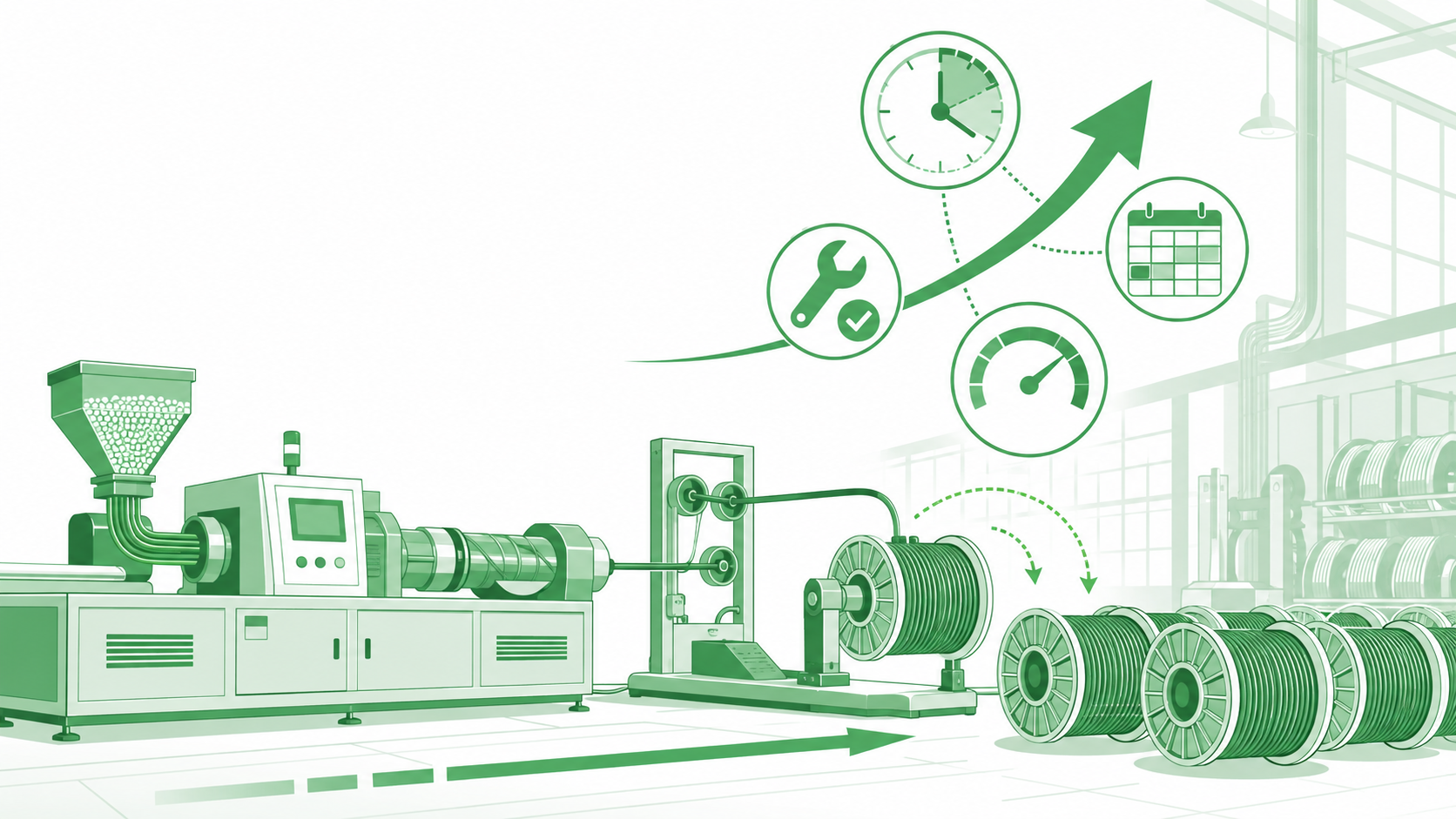
It makes waiting — the extruder idling through a 90-minute changeover, or standing starved because drawing and annealing upstream didn't feed it in time. It makes slowness — a line rated for 500 m/min running at 380 because someone set that speed once, after a die change, and no one ever revisited it. It makes scrap — insulation that drifts out of tolerance, eccentricity that fails at the spark tester, metres you extruded twice because the first pass went to the reject bin, copper you bought, drew, and threw away.
Everything that the second factory "produces" was paid for with real copper, real power and real machine-hours. It just walked out of the building as nothing. Buy a new line while it's running, and all you've done is build a bigger version of it next door.
The Number That Tells You How Big It Is
There's a single figure that measures the second factory, and most plants can't state it for their bottleneck line: OEE — the share of a shift that turns into good cable at rated speed. Availability, speed and quality, multiplied together. Run the maths honestly and most cable plants land somewhere between 45% and 60%. On a plant at 50%, half of everything you own goes to the factory that ships nothing — half your copper throughput, half your power draw, half your labour hours, funding output no customer ever receives.
Now put that next to the quote on the desk. A brand-new line, dropped into a 50%-OEE plant, runs at 50% too — you've bought a second machine to lose half of it in exactly the same way. But move the line you already have from 50% to 65%, and it makes 30% more good cable — same copper, same shifts, same floor, no capital. That isn't optimisation theatre. That's demolishing part of the second factory and keeping the output.
And the clock runs the wrong way for the new machine. That quote is eight months and a commissioning curve away from its first good metre. The recovery inside your current line starts the shift after you begin measuring it. One adds capacity next year; the other adds it this quarter — from a machine that's already paid for.
Where the First Recovery Comes From
You don't get it back with a transformation programme. You get it back by attacking the losses in the order they cost you.
Start by measuring the bottleneck's real OEE — not utilisation, not "it ran all day," an actual number, every shift. You can't recover a loss you refuse to count.
Then take the changeover apart. On most extrusion lines it's the single largest chunk of lost time – pre-stage dies and compound, move every step you can from internal to external, standardise the purge so a colour change takes thirty minutes for the new operator, not ninety. A line that changes over four times a shift gives back hours the same week.
Then re-validate line speed — establish the real safe running speed after each die and compound change and hold the line to it. The gap between the number on the nameplate and the number on the shift log is capacity in plain sight, waiting to be switched back on.
Then sequence the bottleneck's day — group like colours and sizes so the line changes over less, and stop letting a single "urgent" order jump the queue and force a changeover worth more output than the order itself. The extruder sets the plant's pace. Plan the plant around the extruder, not the other way round.
Count It Before You Sign for It
The most expensive way to add capacity is to buy a machine to do work the machine beside it could already do — you just couldn't see that it wasn't. A machine you don't need is the most permanent way to hide a problem you could have fixed.
So before the cheque goes out, measure the plant you already have. The Cable Production Capacity Diagnostic scores where your output actually leaks — waiting, slow running, scrap and planning — line by line, and tells you how much of the new machine you're about to buy is already standing idle inside the old one.
Find that number first. It's the cheapest capacity you'll ever add.
Key Takeaways
- "The lines are full" is not "the lines are producing." Utilisation only proves the machine is on; OEE proves it's making good cable at rated speed.
- Every plant runs a hidden second factory — waiting, slow running and scrap — that burns copper, power and machine-hours and ships nothing. A new line at the same OEE just makes it bigger.
- Moving one line from 50% to 65% OEE yields 30% more cable with zero capital, this quarter — not the next machine's, eight months out. Measure the bottleneck, break down the changeover, re-validate line speed, sequence the day — in that order.
Free Download
The Cable Production Capacity Diagnostic
Score where each line loses output across waiting, slow running, scrap and planning.