
Your Loading Bay Isn’t the Problem. The Delay Started Much Earlier.
Where truck turnaround time actually disappears in ceramic dispatch — and what you should be looking at before adding more bays, vehicles or manpower.
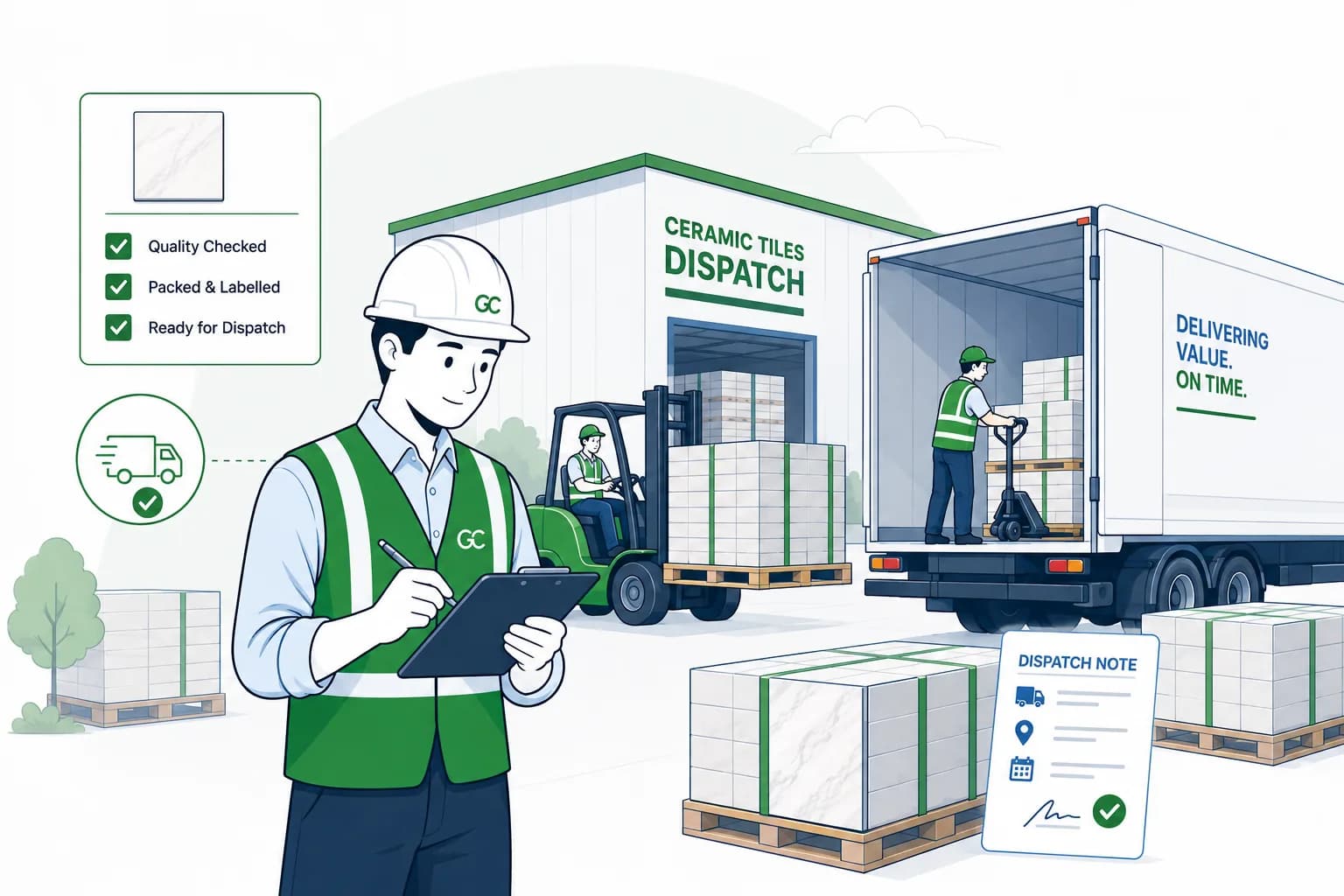
A truck has been inside the plant for over an hour. Naturally, everyone looks at dispatch. Why hasn't it been loaded yet? But then you start asking what actually happened.
The truck arrived on time. The material existed. The loading bay was available. Except the complete order wasn't ready.
Someone was still locating part of the stock. Another batch had to be verified. One quantity was coming from a different storage location. Documents were still being prepared. So yes, the truck was waiting at the loading bay.
But the loading bay wasn't the problem. The delay had started much earlier. And this distinction matters because if you diagnose it as a loading problem, you'll probably try to fix loading.
- More manpower.
- Another bay.
- A different truck schedule.
- Maybe more space.
But none of these fixes a dispatch process that isn't ready when the truck is.
Truck turnaround time is not just loading time
Start with the entire movement.
Gate-in → Order readiness → Stock location → Batch allocation → Picking → Staging → Loading → Documentation → Gate-out
Now measure where the time actually goes. Because a truck that spends 90 minutes inside the plant may only spend 25 minutes being physically loaded. Where did the other 65 minutes go?
That is the number worth investigating. And in ceramic dispatch, it usually takes you further upstream than the loading bay.
The stock is available. But where exactly is it?
This sounds ridiculously basic. Until a dispatch team has an order to load and somebody has to physically search for the material. The system says there are 500 boxes.
Fine… Which location? Which batch? Is that what is physically available? Has part of it already been allocated somewhere else? Can the person picking the order go straight to the material, or do they first need to ask someone who “knows where it is”?
That last part is usually where the problem shows itself.
If routine dispatch depends on someone's memory, a phone call or physically checking multiple locations, you don't really have inventory visibility. You have inventory information. There's a difference.
And every five or ten minutes spent figuring this out eventually lands on truck turnaround time.
Finding the SKU is only half the problem
Ceramics adds another layer — batch and shade. Having the right product does not automatically mean having the right stock for that order. The batch still needs to be identified, allocated and available in the required quantity.
If this happens after the truck has arrived, dispatch becomes the point where every upstream miss suddenly becomes urgent.
- Wrong batch? Check again.
- Quantity short? Find the remaining stock.
- Material stored somewhere else? Bring it across.
- Allocation changed? Redo the pick.
None of these looks like a huge failure on its own. But stack five small delays together and you have a truck sitting inside the plant doing absolutely nothing. That's how turnaround time gets lost. Not always in one massive bottleneck.
Sometimes in ten small ones nobody is measuring.
“Picked” and “ready to load” are not the same thing
This one is important. An order can be picked without being load-ready.
If half the material is sitting near the bay while the rest is still being moved from storage, the truck has already become part of your staging process. It shouldn't be.
Ideally, when that vehicle reaches the loading point, the complete order should already be there.
- Correct product.
- Correct batch.
- Correct quantity.
- Required clearance completed.
- Documents in process.
- Ready to move.
The question therefore isn't only:
“How quickly are we loading?”
Ask:
"Was the order completely ready before the truck reached the bay?"
That one question can change where you look for the problem.
Then there's the follow-up chain
- Has picking finished?
- Where is the remaining quantity?
- Which batch are we sending?
- Has the truck arrived?
- Is the bay free?
- Are the documents ready?
- Can loading start?
If answering these questions needs five calls, three WhatsApp messages and somebody walking across the warehouse, the process is already telling you something.
The information exists. It just isn't connected.
Warehouse has one status. Dispatch has another. Transport has another. And the customer or dealer waits for somebody to manually tell them what is happening.
This is where a WMS or TMS can help — but only when it is supporting a properly designed process. Putting software on top of the same broken workflow simply gives you a digital view of the same problem.
Before adding capacity, check readiness
When trucks queue up, adding another loading bay feels like the obvious answer. Sometimes it is… But first, look at a few actual dispatches and timestamp them.
- When did the truck enter?
- When was the complete order picked?
- When was the correct batch confirmed?
- When did staging finish?
- When did loading actually begin?
- When was loading completed?
- When were the documents ready?
- When did the vehicle leave?
You may find that loading itself is perfectly fine. The truck is waiting because preparation started too late. That is a very different problem. Material, batch, dock, vehicle and documents cannot operate as five separate updates and somehow become one smooth dispatch at the end.
They need one readiness decision.
Is this order genuinely ready to dispatch?
Yes or no.
What changes when the process is connected?
This isn't theoretical for us.
In one ceramics implementation, Gemba integrated warehouse and transport workflows through WMS and TMS. The implementation delivered 99.9% inventory accuracy and a 50% reduction in truck turnaround time, while also giving customers real-time visibility into their dispatch.
No client name. No magic dashboard.
The important part is what changed underneath it:
The warehouse knew the stock. The operation could control the movement. Transport was connected to actual dispatch readiness. And visibility did not depend on somebody manually chasing an update.
That is the outcome you want.
Not “faster loading.”
A dispatch process where the truck arrives when the order is actually ready for it.
So, where is your dispatch time going?
If truck turnaround is consistently high, don't begin with the assumption that you need another bay.
Follow one truck → From gate-in to gate-out → Then follow the order backwards.
You'll usually find the waiting time somewhere between inventory visibility, batch allocation, picking, staging, vehicle planning and documentation.
The truck is just where the problem finally becomes visible.
Find the gaps before you try to fix them
Already seeing repeated truck delays? We'll look at the current process, baseline where time is being lost and identify what actually needs to change — across process, warehouse and supporting technology.
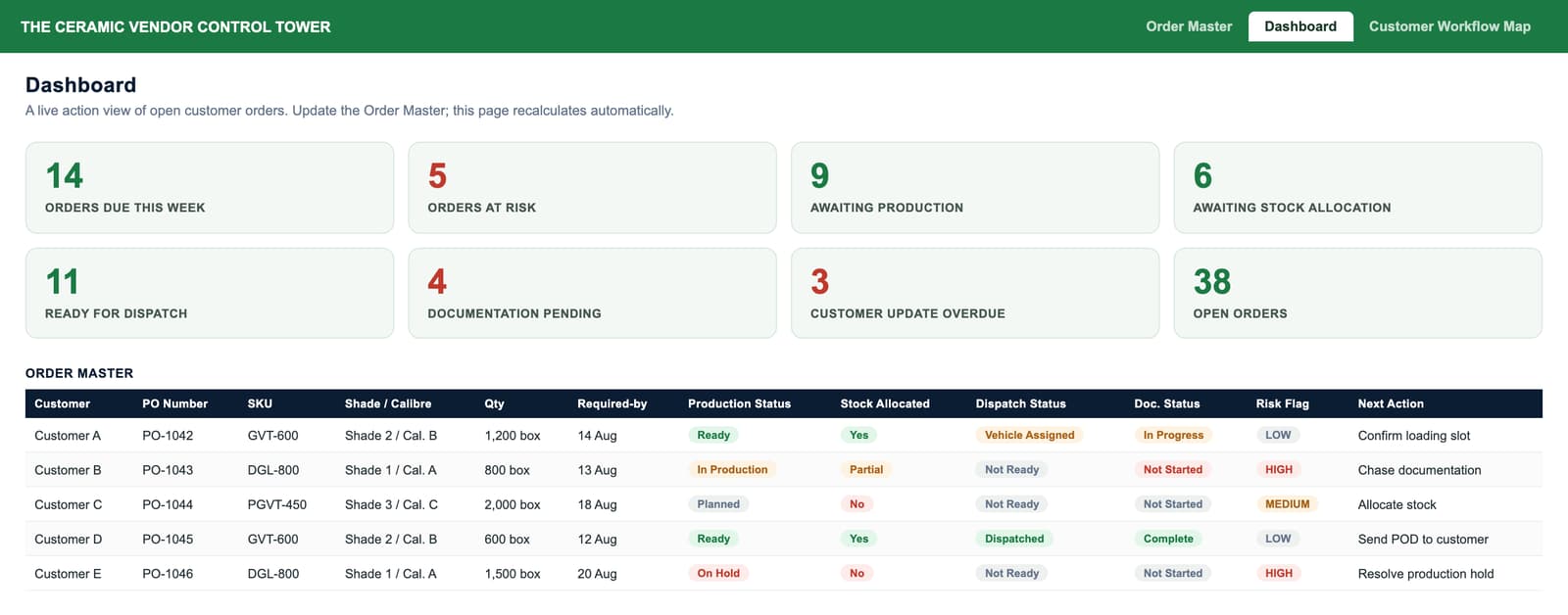
The Ceramic Vendor Control Tower
A ready-to-use Excel tracker for customer POs, production, stock and dispatch readiness.
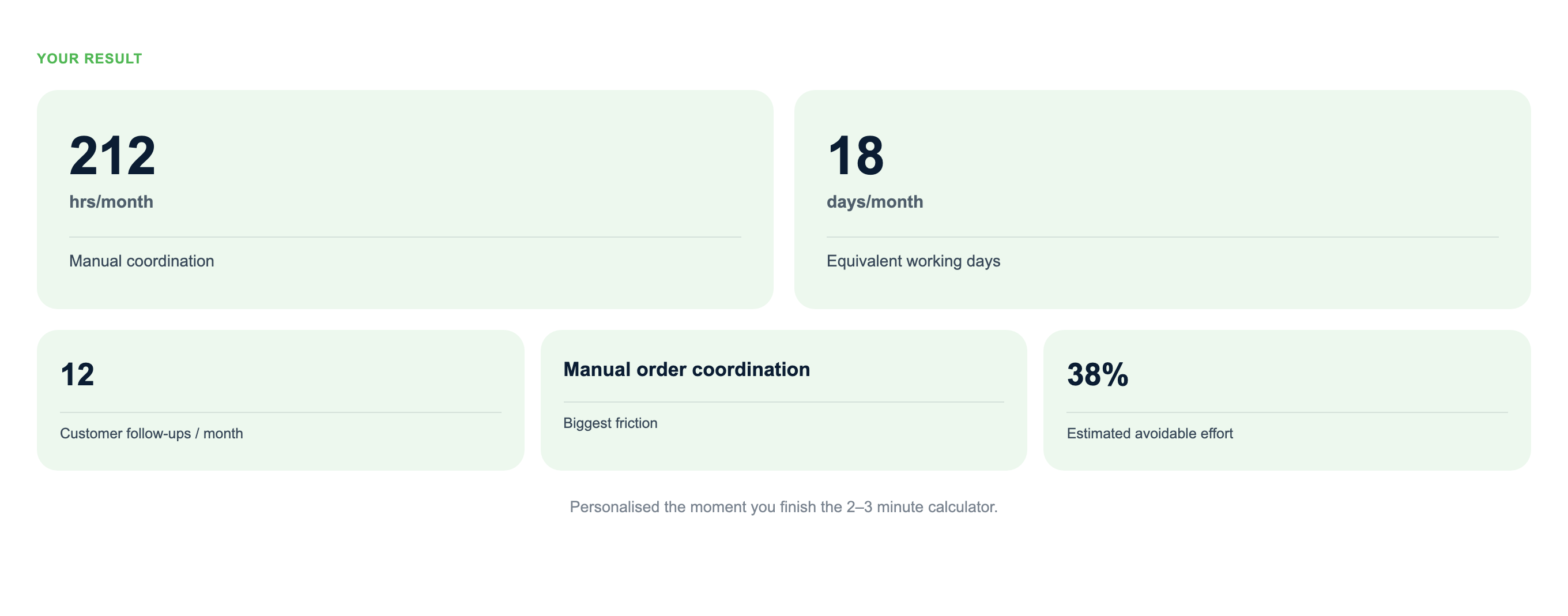
How many hours a month is order coordination taking?
Ten questions about how orders reach you and how often they get chased. You get the monthly hours, what that is in working days, and which of the three frictions is costing you most.
Less searching. Less handling. Faster dispatch.
Talk to a Gemba consultant about your specific dispatch bottlenecks.
